


Navigation
Contact us
Phone
Message
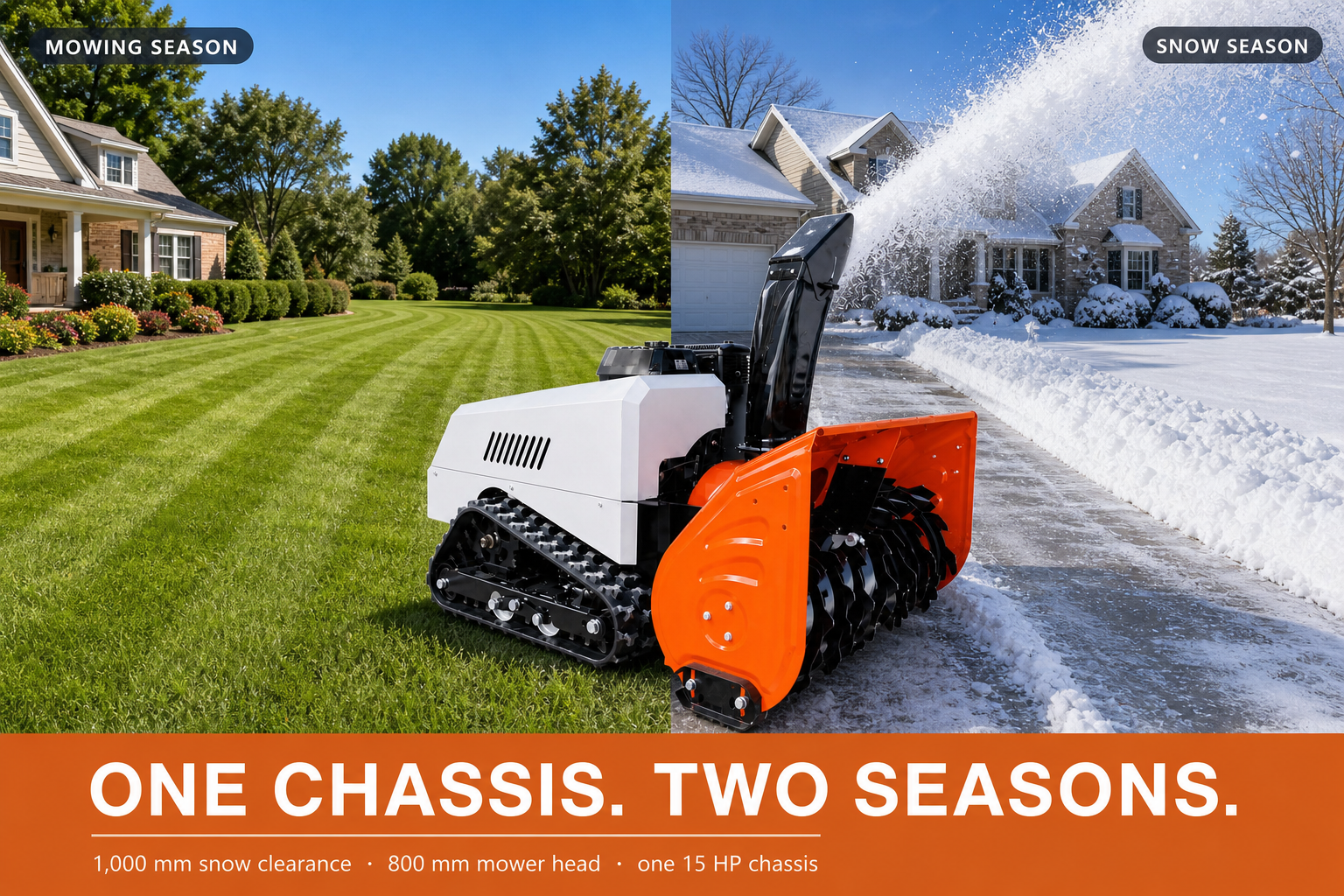
One remote-controlled crawler, two working seasons. What the second season is worth against a second machine, which attachment takes which job, what actually changes for the operator, and when to order the head.
VOER's 1000T-Pro is a remote-controlled crawler snow thrower with a front mounting point that also takes an 800 mm mower head. The platform does not change between the two configurations: the same Loncin 420 engine, the same 120 mm tracks and their two 500 W drive motors, the same transmission and the same 500 m handset carry the machine through snow clearance in one season and cutting in the other.
That leaves four questions to settle before the machine is ordered, or before the head is added to one already in service. They arise in a fixed order: whether the second season pays, which attachment takes which job, what the operator does differently, and when to buy the head.
The arithmetic in Decision 01 is a worked illustration. The inputs are stated assumptions and the arithmetic on those inputs is exact. Put your own season lengths into the same formula and it returns your own figure.
At a glance
Decision 01 · Does the second season pay for the machine?
Snow clearance is bought for a few weeks of the year and owned for twelve months. A depot or a contractor that buys for snow alone holds a machine that idles through the growing season, and the conventional answer — a second machine for summer — doubles what has to be serviced, trained on and stored. The mower head is the alternative: the machine already on site takes on the summer work.
Four inputs decide the arithmetic, and a buyer already knows all four:
• Chargeable snow days in a year.
• Chargeable days of grass and vegetation work in a year.
• Whether a second machine would otherwise be bought for the summer work.
• What a second machine costs in servicing, operator training and storage space.
The machine's annual ownership cost is carried by the days it can work. Snow alone gives one number of chargeable days; snow and mowing together gives the sum of both. The overhead each chargeable day has to absorb is the annual ownership cost divided by the chargeable days.
Worked illustration. Assume 30 chargeable snow days and 120 chargeable days of grass work. Snow alone: 30 days carry the whole year. Snow with the mower head: 150 days carry the same year. 150 divided by 30 is 5, so the same annual ownership cost is spread across five times as many chargeable days, and the overhead each chargeable day absorbs is one fifth. Against the alternative of a second machine, the engine, the tracks, the handset and the storage bay all stay at one.
Across a year the machine meets four ground states, and each one already has an attachment assigned to it:
What it decides: how many days a year the asset can be charged to, and therefore what each of those days has to carry.
Decision 02 · Which attachment takes which job?
Both attachments fit the same front mounting point and take their drive from the host engine, so the choice is about the work in front of the machine rather than about the machine itself.
A third attachment, an optional snow head, fits the same mounting point and is driven from the host engine in the same way.
What it decides: the attachment list on the order, and whether one head covers the ground the machine will actually see.
Decision 03 · What changes for the operator?
Nothing in the operator's hands changes. The 500 m handset with remote-controlled lift is the same unit in both configurations, the machine is driven to the work on its own tracks, and the operator stands clear with the machine in line of sight throughout.
The changeover is kept to the front of the machine. The front attachment and its drive belt are the only parts involved: the Loncin 420 engine, the two 500 W track motors on 120 mm tracks, the transmission, the 500 m handset and the remote-controlled lift are the same components in both configurations. No specialist tooling is required, no second control system has to be commissioned, and nothing behind the mounting frame is adjusted — so the machine that left the yard for snow work is the machine that goes out for grass work.
What it decides: how much of the operator's routine and training carries across unchanged.
Decision 04 · When to order the head?
The head can travel with the machine or follow it later. The freight arithmetic is what separates the two paths.
The mower head packs and ships separately, which is what allows a dealer to hold heads against demand rather than ordering one with every machine. Host and snow head continue to load 12 units to a 20 ft container and 28 to a 40 ft.
What it decides: whether the head is capital committed now or stock positioned against the summer order book.
Winter configuration
Summer configuration
Packing and container loading
Who each configuration suits
Safety Notes
• Keep the machine in clear line of sight while operating. The 500 m control range is an operating limit, not a working distance; shorten it wherever terrain, trees or buildings break the view.
• Wear eye and hearing protection when working close to the machine.
• Stop the engine before changing an attachment, clearing a blockage, or inspecting the auger, impeller or blades.
• Keep all guards and shields fitted whenever the engine is running, and never allow anyone to stand in line with the discharge chute or the cutting head.
• Keep hands, feet and clothing clear of the feed and cutting areas, and never reach into an attachment to clear material while the engine is running.
Frequently Asked Questions
What does the 1000T-Pro do in winter?
In snow configuration it clears 1,000 mm (39.37 in.) per pass at working depths of 2–60 cm, throws snow up to 15 m through a 360° chute set from the handset, and climbs to 45° on 120 mm tracks, all from the 500 m handset with remote-controlled lift.
What does it do in summer?
It takes an 800 mm (31.5 in.) mower head on the same front mounting point, cutting at heights from 20 mm to 120 mm (0.79 to 4.72 in.) on a straight blade.
Does the mower head need its own engine?
No. The head is driven by belt from the host engine, on the same tensioner used for the snow head.
Which parts are involved in the changeover?
The front attachment and its drive belt. No specialist tooling is required, no second control system has to be commissioned, and nothing behind the mounting frame is adjusted.
Can one operator run both configurations?
Yes. The 500 m handset with remote-controlled lift is the same unit in both configurations, and the machine drives itself to the work on its own tracks.
How does the machine reach steep ground?
On its own tracks, up to 45°, controlled from the handset rather than from a seat on the machine.
How is it shipped?
Host and snow head pack at 1,660 × 1,160 × 1,060 mm and 340 kg, loading 12 units to a 20 ft container and 28 to a 40 ft. The mower head packs separately at 1,020 × 950 × 600 mm and 110 kg.
What certification does it carry?
The Loncin 420 engine is certified to EPA / Euro 5.
Summary
The 1000T-Pro is one remote-controlled crawler platform that works two seasons. Whether the second season pays comes down to how many chargeable days a year the machine can be given, set against what a second machine would cost to run, train on and store. Which attachment takes which job is settled by the ground: the 1,000 mm snow head for snow cover and frozen surfaces, the 800 mm mower head for amenity grass, verge, embankment and orchard rows. What changes for the operator is the attachment at the front and nothing else — the same 500 m handset, the same tracks, the same engine, and a changeover confined to the front attachment and its drive belt. When to buy the head is a freight decision, because the head packs and ships separately at 1,020 × 950 × 600 mm and 110 kg and can therefore be positioned against the summer order book rather than committed with every machine.
VOER supplies compact machinery for snow clearance, grounds care and material handling.
This stunning beach house property is a true oasis, nestled in a serene coastal community with direct access to the beach.
Contact
West Street, Melbourne Victoria 3000 Australia