


Navigation
Contact us
Phone
Message
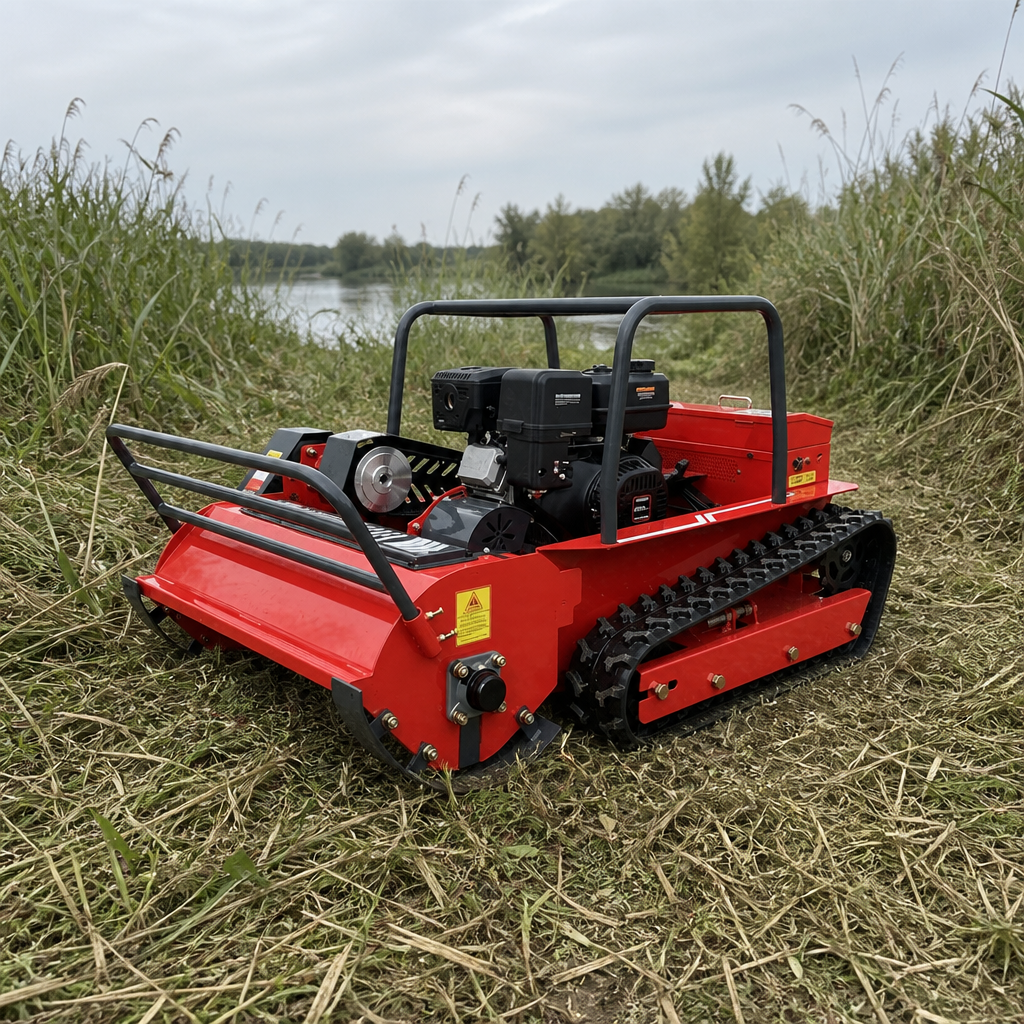
A remote-controlled crawler mower with oil-electric hybrid drive, a 40-blade serrated cutting rotor and a 400 m remote control range, built for ground that is too steep or too awkward to mow from a seat.
1. What the T100J Is Built For
The VOER T100J is a remote-controlled crawler mower built around a 1,000 mm cutting width, a cutting height range of 20 mm to 200 mm, and a remote control range of 400 m. Its drivetrain is described as oil-electric hybrid, it climbs slopes up to 30°, and it works at a rated efficiency of 5,000 m²/h.
Those figures describe a single job: keeping banks, embankments, verges and row middles cut on a regular cycle while the operator stands well clear of the blade deck. On this class of ground a ride-on mower puts the operator on the slope, and a pedestrian mower puts the operator right beside the cut. A tracked remote-controlled machine moves both of those risks away from the person doing the work.
The T100J is also a platform rather than a single fixed specification. It is offered with five engine configurations covering air-cooled petrol and diesel units in single- and twin-cylinder form, and the cutting deck can be fitted with either a 40-blade serrated set or a 16-piece hammer-claw set depending on the grass and growth it will meet.
2. Full Specification Overview
3. Engine Options: Petrol or Diesel, Single or Twin Cylinder
The T100J is supplied with a choice of engines rather than one fixed unit. Two configurations are standard — a Loncin 459 air-cooled single-cylinder petrol engine, and a KOOP 192 air-cooled single-cylinder diesel engine. Three further engines are available as options: a larger single-cylinder diesel, a twin-cylinder petrol unit, and a twin-cylinder diesel unit.
Depending on the engine configuration selected, rated power ranges from 12 HP to 23 HP, fuel tank capacity ranges from 5.5 L to 12 L, and oil capacity ranges from 1.1 L to 2.8 L. Rated engine speed is 3,600 rpm.
That spread matters commercially as much as technically. A single-cylinder petrol machine and a twin-cylinder diesel machine of the same nominal class are bought by different customers: one is looking for a light, straightforward unit for seasonal grass work, and the other wants continuous output for heavier growth and longer duty cycles. Selling the same platform into both segments is the reason the engine list is this long, and it is worth settling the engine choice before comparing prices across suppliers rather than after.
4. Cutting Width, Cutting Height and the Blade Set
The T100J cuts 1,000 mm wide and adjusts between 20 mm and 200 mm. Read the two numbers together: a 1,000 mm cut sets how many passes a job takes and therefore the labour cost of a contract, while a 20–200 mm range sets what kind of ground the machine can be sent onto. The low end covers maintained turf; the upper end is for longer, rougher grass cover that a fine-cut mower would simply flatten.
The standard cutting set is 40 blades arranged as 20 per side, using 6 mm custom manganese steel serrated blades. Manganese steel is the right material choice for this duty because it resists the abrasion that comes with ground contact, grit and woody stems. A 16-piece hammer-claw set is available as an alternative for heavier growth, which makes the deck interchangeable between finishing work and rougher clearance without changing the machine.
Deck height is adjusted manually as standard, and a remote deck lift is available. That option is worth understanding before purchase: on a slope, being able to change cutting height without walking up to the machine keeps the operator in one safe position instead of crossing the incline between passes.
5. Tracked Chassis and 30° Slope Capability
The T100J runs on tracks 150 mm wide. Tracks spread the machine’s 346 kg over a larger contact area than wheels, which is what gives the grip on soft, wet and uneven ground where a wheeled mower starts to slip or cut ruts. The same contact area is what allows the machine to hold a line across a slope rather than sliding down it.
The rated climbing angle is up to 30°. As with any slope rating, this is the capability of the machine on suitable ground rather than a guarantee for every surface. Wet grass, loose gravel, soft turf and leaf litter all reduce the angle that can be held on the day, so the achievable angle on a specific site should be established on site before the machine is put to work there.
6. Remote Control Range and Operator Position
Remote control range is 400 m (1,312 ft). That distance is an operating limit rather than a working method. The practical rule on every remote-controlled mower is to keep the machine in clear line of sight and to shorten the working distance wherever ground shape, trees, buildings or fencing break the view. What the range buys you is the ability to stand on solid, level ground and mow a bank that you would not walk across with a pedestrian mower.
7. Oil-Electric Hybrid: How the Power System Works
The T100J uses an oil-electric hybrid arrangement. A petrol or diesel engine provides the primary power, an 850 W brushless motor drives the cutting system, and an on-board 2,000 W generator keeps the electrical side supplied, supported by a 24 V, 20 Ah battery. Rated engine speed is 3,600 rpm.
Splitting the drive this way has a practical consequence: the cutting system is electrically driven rather than mechanically coupled to the engine, so cutter response does not depend only on engine speed. A brushless motor also removes the carbon brushes, which is the part that wears on a conventional motor and the part that has to be serviced. The battery keeps the electrical system stable when the generator load changes, and the 2,000 W output is the figure to check if you intend to run anything else from the machine.
8. Working Efficiency and What It Means in the Field
Rated working efficiency is 5,000 m²/h, which is 0.5 hectare per hour. That is the number to use when costing a contract. Divide the area of the job by 5,000 to get machine hours, then compare that against the hours the same job would take with a pedestrian mower or a ride-on unit.
Two cautions on that figure. First, it is a rated rate, and real output falls as ground gets steeper, grass gets longer, and turns and obstacles increase. Second, machine hours are not labour hours on a remote-controlled mower — one operator can supervise the machine rather than walk behind it, so the labour comparison should be made on operator hours, not on mowing hours alone.
9. Where the T100J Fits
10. Wooden-Crate Packing and Shipping
Shipping figures are defined on the specification sheet. The machine measures 1,560 × 1,170 × 820 mm and weighs 346 kg (763 lb) net. It is packed in a wooden crate measuring 1,620 × 1,220 × 1,030 mm, with a gross weight of 415 kg (915 lb). Those numbers are what a freight forwarder needs in order to quote the shipment and to work out container loading, so they should be taken from the current specification sheet rather than from an older quotation.
The 69 kg (152 lb) difference between net and gross weight is the crate itself and the packing. On a single unit that is a rounding detail; on a container load it is the difference between one more machine fitting or not, so it is worth checking against the loading plan before a multi-unit order is confirmed.
11. Configuration Points Worth Settling Before the Order
• Engine configuration. Settle petrol or diesel, and single- or twin-cylinder, before comparing quotations. It changes the machine’s duty cycle and it is the single biggest variable in the specification.
• Cutting set. Confirm whether the standard 40-blade serrated set, the 16-piece hammer-claw set, or both, are required for the grass and growth on your sites.
• Deck lift. Decide whether manual or remote deck lift suits the terrain. On steep ground the remote option changes how safely height changes can be made.
• Blade and wear-part stock. Ask for the blade set and wear parts to be itemised with the quotation. Consumable planning starts on day one of ownership, and prices confirmed at the order stage are easier to budget than prices found mid-season.
• Ground survey. Record the steepest slope, the surface type and the grass height the machine will actually meet. The rated climbing angle is a specification; the achievable angle on your ground is a survey result.
• Operator training. Remote operation is a skill. Time spent on flat, open ground before the first slope job is cheaper than time spent recovering a machine.
Safety note: This is a remote-controlled machine with a rotating cutting rotor. Keep people, animals and bystanders well clear of the cutting deck whenever the engine is running, and never treat the remote control as a substitute for physical distance. Wear eye and hearing protection when working near the machine, keep all guards and discharge shields fitted, and stop the engine before clearing a blockage or inspecting the deck. Work within the rated climbing angle, keep the machine in clear line of sight, and reduce the working distance wherever the ground or an obstacle blocks the view. Assess any slope before the first cut — wet, loose or soft ground changes the angle at which a machine can be held safely.
FAQ
What is the VOER T100J?
A remote-controlled crawler mower with a 1,000 mm cutting width, a 20–200 mm cutting height range, a 400 m remote control range and a rated climbing angle of up to 30°, with oil-electric hybrid drive and a rated working efficiency of 5,000 m²/h.
Is the T100J petrol or diesel?
Both. Two configurations are standard — a Loncin 459 air-cooled single-cylinder petrol engine and a KOOP 192 air-cooled single-cylinder diesel engine — and three further engines are available as options, including twin-cylinder petrol and diesel units. Rated power ranges from 12 HP to 23 HP depending on the configuration selected.
How wide does it cut, and how low can it go?
1,000 mm (39.37 in.) cutting width, with cutting height adjustable from 20 mm to 200 mm (0.79 in. to 7.87 in.).
What blades does it use?
The standard set is 40 blades arranged as 20 per side, using 6 mm custom manganese steel serrated blades. A 16-piece hammer-claw set is available as an alternative for heavier growth.
Can the cutting height be adjusted remotely?
Deck height is adjusted manually as standard, and a remote deck lift is available as an option.
How far away can the operator stand?
The remote control range is 400 m (1,312 ft). Keep the machine in clear line of sight and shorten the working distance where the view is interrupted.
What does oil-electric hybrid mean on this machine?
A petrol or diesel engine provides the primary power, an 850 W brushless motor drives the cutting system, and an on-board 2,000 W generator supports a 24 V, 20 Ah battery. Rated engine speed is 3,600 rpm.
How much does it weigh, and how does it ship?
Net weight 346 kg (763 lb). Machine dimensions are 1,560 × 1,170 × 820 mm. It ships in a wooden crate measuring 1,620 × 1,220 × 1,030 mm, with a gross weight of 415 kg (915 lb).
Summary
The VOER T100J is specified around a 1,000 mm cutting width, a 20–200 mm cutting range, a 400 m remote control range and a rated climbing angle of up to 30°, with oil-electric hybrid drive, a 40-blade manganese steel serrated rotor and a 5,000 m²/h rated working efficiency. Five engine configurations from 12 HP to 23 HP let the same tracked platform be specified for seasonal grass work or for heavier continuous duty.
VOER supplies the T100J remote-controlled crawler mower and other compact machinery for grounds managers, contractors, municipalities and equipment dealers. For current specification sheets, configuration options and shipping details for your market, contact the VOER team.
This stunning beach house property is a true oasis, nestled in a serene coastal community with direct access to the beach.
Contact
West Street, Melbourne Victoria 3000 Australia