


Navigation
Contact us
Phone
Message
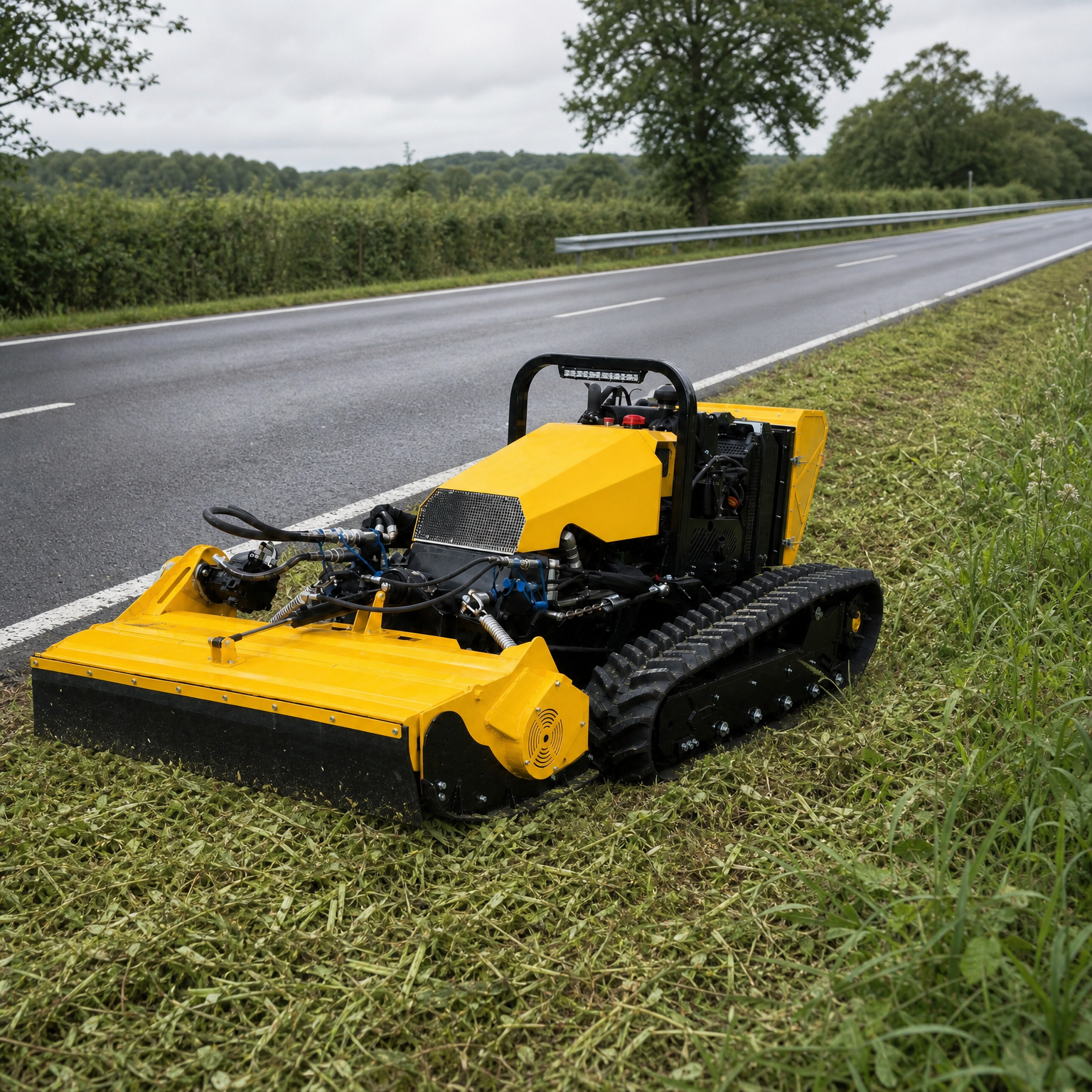
Slope angle, what is growing on it, how much you cut in one session, what is standing in the cut and how the machine is refuelled decide whether a 1,350 mm, 55° slope mower is the right machine — and how it should be set up to work.
Almost every first enquiry about a slope mower opens with the same four words: how much is it. It is a fair question, and it is almost always the wrong one to start with, because the answer moves with five things that only the buyer can measure. These are the five questions we ask before we put a price on a T40S. Buyers who work through them first tend to get a quotation that fits on the first pass, and a delivery date they can plan around.
There is a second reason to answer them honestly. A slope mower bought for a slope it cannot hold is not a discount, it is a write-off with a warranty. The working envelope of the T40S is published below, in numbers, so that you can rule yourself in or out before anyone spends time on a quotation.
At a glance
01 · How steep is the steepest part, measured on the slope itself?
Slope figures are usually taken from a map, from the flattest section, or from memory — and all three flatter the job. The machine has to hold the worst ten metres, not the average. Measure that section with a clinometer or an inclinometer while standing on it, and quote the number you measured.
• Under 25°: any slope mower in the range will cope. The T40S is more machine than this job needs, and we will say so rather than sell it to you.
• 25° to 35°: the mainstream working band, and the easiest to plan around.
• 35° to 45°: the band where a low centre of gravity and fine hydrostatic control stop being features and start being the difference between a clean cut and a slide.
• 45° to 55°: the top of the T40S envelope. Here the deciding factor is no longer power — it is whether the operator can be kept off the slope entirely, which is what the remote range is for.
What it decides: whether the T40S is the right machine at all.
02 · What is growing on the slope?
The same slope behaves like three different jobs depending on the cover. Fine turf is a coverage problem. Rough grass and bramble are a power problem on the first pass. Woody regrowth is neither: a slope mower is not a forestry mulcher, and stems beyond the capacity of the deck have to be cleared before the mower arrives, not by it.
• Fine turf: the limiting factor is how fast the machine can safely be driven, so the 8,000–10,000 m²/h band is realistic.
• Rough grass and bramble: plan two passes. The first is a reduction pass and is not a finish cut.
• Saplings and woody stems: send the stem diameter and we will tell you whether it is a mower job or a clearing job.
• Mixed cover: expect a different pass strategy on different parts of the same slope.
What it decides: how many passes a hectare really costs.
03 · How far is the longest single run, and how much area in one session?
The 28 litre tank and the coverage band set the refuelling interval, and the interval sets the shape of the working day. On a long run the plan is not laps, it is refuelling points: where the diesel is, and how it reaches the slope.
• Report area per session, not per year. A hectare of 40° slope is not a hectare of sports field.
• Give the longest continuous run as well as the total. A machine that finishes the area but runs dry every hour wastes the operator, not the mower.
What it decides: the working day, and the fuel plan.
04 · What is standing in the cut?
The cutting width is 1,350 mm, and that single number decides whether the machine passes between the rows or works them one at a time. Trees, fence posts, panel legs, drainage channels and retaining walls change the working method before they change the machine.
• Solar arrays and orchard rows: send the clear width between rows. It is the number that decides the method.
• Drainage channels and kerbs: tell us the profile. A drop is a stability question, not a mowing question.
• Trees and posts: send photographs taken from the bottom of the slope, where each obstacle sits against the fall line.
What it decides: the working method, and the control position.
05 · How does fuel reach the slope, and who stands where?
The point of a remote machine is that the operator is not on the slope. That has to be planned rather than assumed: decide where the operator will stand, confirm line of sight along the whole run, and only then lay out the machine's path. Diesel is the other half of the same plan — 28 litres has to reach the slope, and the machine will not fetch it.
• Confirm there is line of sight to the machine at every point of the run.
• Confirm the machine cannot leave the slope onto a road, a path or a building if traction is lost.
• Confirm who is authorised to approach the machine, and where the stop is.
What it decides: the safety plan, and whether the job can be done at all.
Your five answers, and what we send back
What to send us
• The steepest angle in degrees, measured on the slope
• Longest continuous run, and total area per session
• Three photographs: from the bottom, from the top, and the worst section
• Ground cover: turf, grass, weeds, bramble or woody
• Obstacles inside the cut, with the clear width between rows where relevant
• Destination port, quantity, and any certification requirement for your market
The machine in numbers
Safety notes
• Measure the slope on the slope. Do not estimate it from a map, a photograph, or from the seat of another machine.
• Keep people, animals and vehicles outside the working radius. A remote machine is remote, not unguarded.
• Keep line of sight to the machine at all times. Remote range is an operating limit, not a licence to work blind.
• Stop the engine before clearing a blockage, changing a blade, or reaching under the deck.
• Wear eye and hearing protection near the machine; the discharge side throws cut material.
• Do not work a slope from which the machine could reach a road, a path or a building if traction is lost.
Frequently asked
What slope can the T40S mow?
Up to 55°, measured on the slope itself. That is a working limit, not a survival limit, and we will not confirm a slope from a description alone. A photograph and a measured angle are the minimum.
How much area can it cover in a day?
The published band is 8,000–10,000 m²/h under normal conditions. Slope angle, cover and obstacles take it down from there. Give us the hectares and the angle, and we will plan against the band rather than against a best case.
Does anyone have to ride on it?
No. One operator works it from the remote handset, up to 300 m away. Keeping the operator off the slope is the reason the machine exists.
What engine and fuel does it use?
A Yanmar 3-cylinder diesel with direct injection, 28.2 kW (38.3 hp) at 2,600 rpm and 107.7 Nm, on a 28 litre tank.
What if my slope is steeper than 55°?
Then the T40S is the wrong machine, and we will say so. Send the profile anyway: we would rather lose a quotation than place a machine on a slope it cannot hold.
What do you need in order to quote?
The five answers on this page, plus destination port and quantity. The more of them you send, the fewer questions come back before a price.
Summary
Slope mowing is decided by the slope, not by the machine. Measure the steepest section where it is steepest, establish what is growing on it, count the area you cut in one session, list what is standing in the cut, and settle how fuel and the operator reach the site. Once those five answers exist, the question of which machine and which price has one defensible answer. The T40S covers 1,350 mm at up to 55°, on a 28.2 kW Yanmar diesel with hydrostatic control and a 300 m remote. Send the five answers and we will reply with the configuration, the delivery date and the price.
About VOER
VOER supplies remote-controlled and crawler machinery for slope, grounds-care, forestry and snow work — slope mowers, log splitters, branch chippers, mini loaders and snow equipment — to contractors, municipalities, estates and forestry operations. Machines are CE marked and shipped FOB Qingdao.
Send the five answers through the enquiry form at voergroup.com. The more of them you can fill in, the fewer questions come back before a price.
This stunning beach house property is a true oasis, nestled in a serene coastal community with direct access to the beach.
Contact
West Street, Melbourne Victoria 3000 Australia