


Navigation
Contact us
Phone
Message
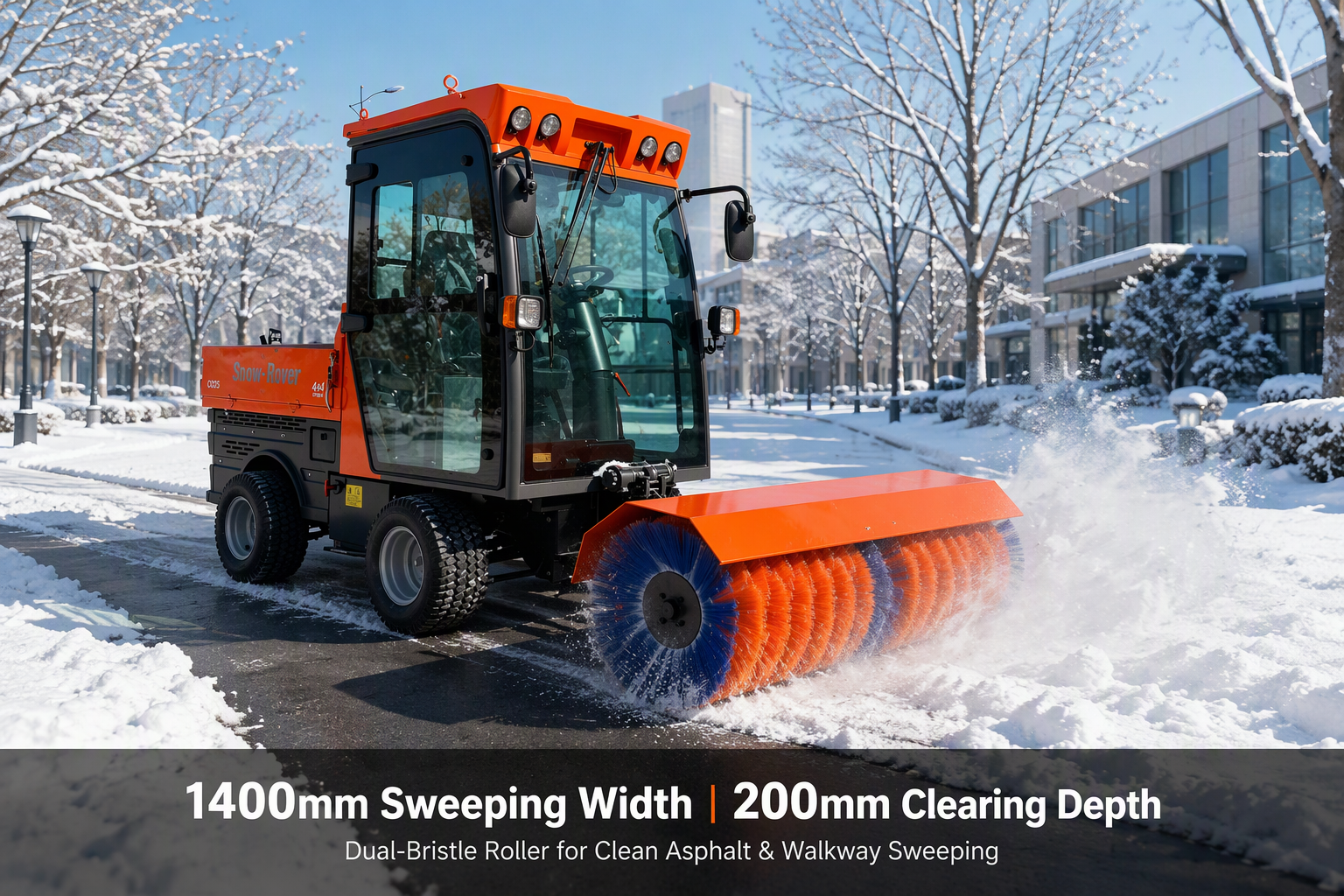
One Chassis, Four Winter Tools
The VOER 4WD140 brings sweeping, throwing, plowing and spreading to one ride-on snow-clearing platform — so the tool can change when the surface, snow condition or finishing standard changes.
VOER | 4WD140 Multi-Function Snow Sweeper | Product News
Snow clearing is rarely one identical job from the first pass to the last. A deep windrow at the entrance needs a different tool from a thin layer on block paving. A gravel shoulder needs a different approach from an asphalt parking lot. The VOER 4WD140 is built around that practical difference: one ride-on chassis carries four front-working options — a roller brush, snow thrower, push blade and spreader — so operators can choose the attachment that matches the ground in front of them.
The platform combines a 25 HP power unit, continuously variable transmission, cruise control, multi-gear four-wheel drive and a fully enclosed heated cab. The result is a machine designed for repeated winter routes across private estates, commercial parking areas, farms, industrial yards, public paths and access roads. Instead of asking one attachment to perform every task, the operator can open, move, finish and treat the surface in a controlled sequence.
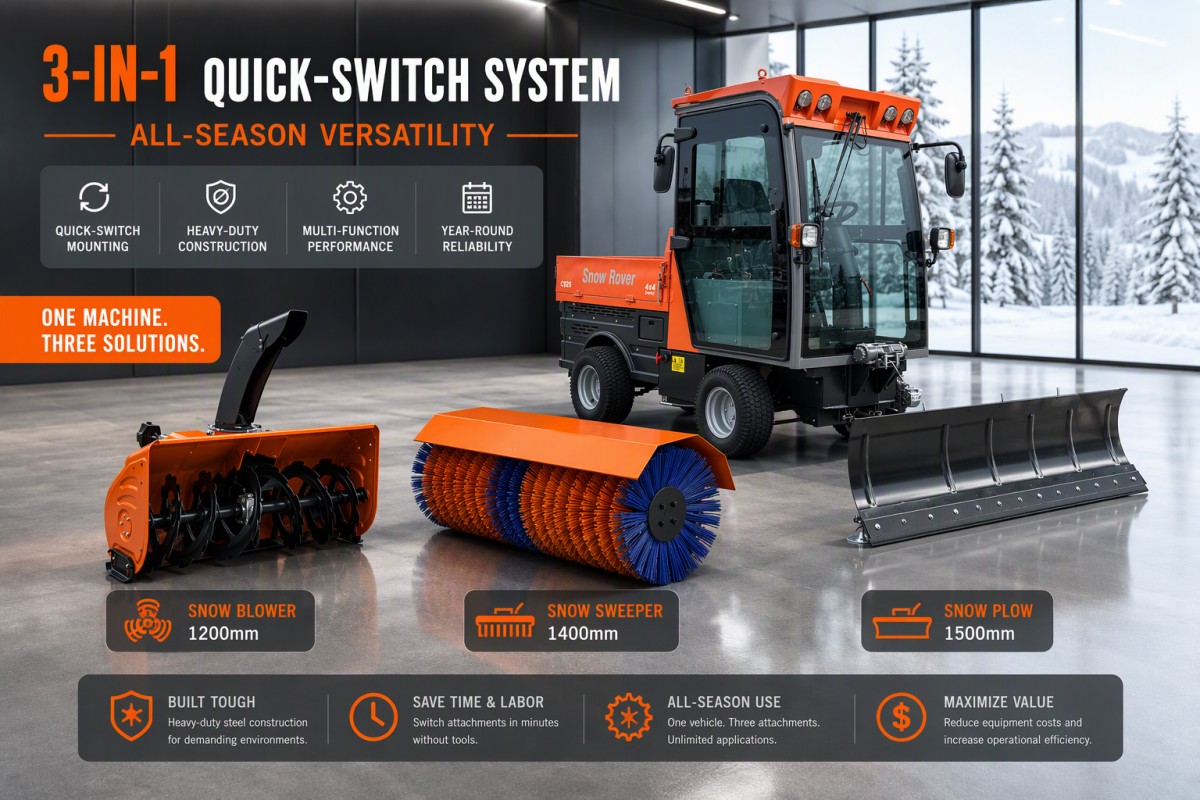
Three front-tool options shown for the VOER 4WD140: roller brush, snow thrower and push blade. A rear spreader completes the four-tool configuration.
Why the 4WD140 is built for changing winter conditions
The 4WD140 is not simply a snow brush with extra accessories. Its value comes from the relationship between the chassis, the drive system and the interchangeable tools. Each part answers a different operating problem.
01 Roller brush for the finish
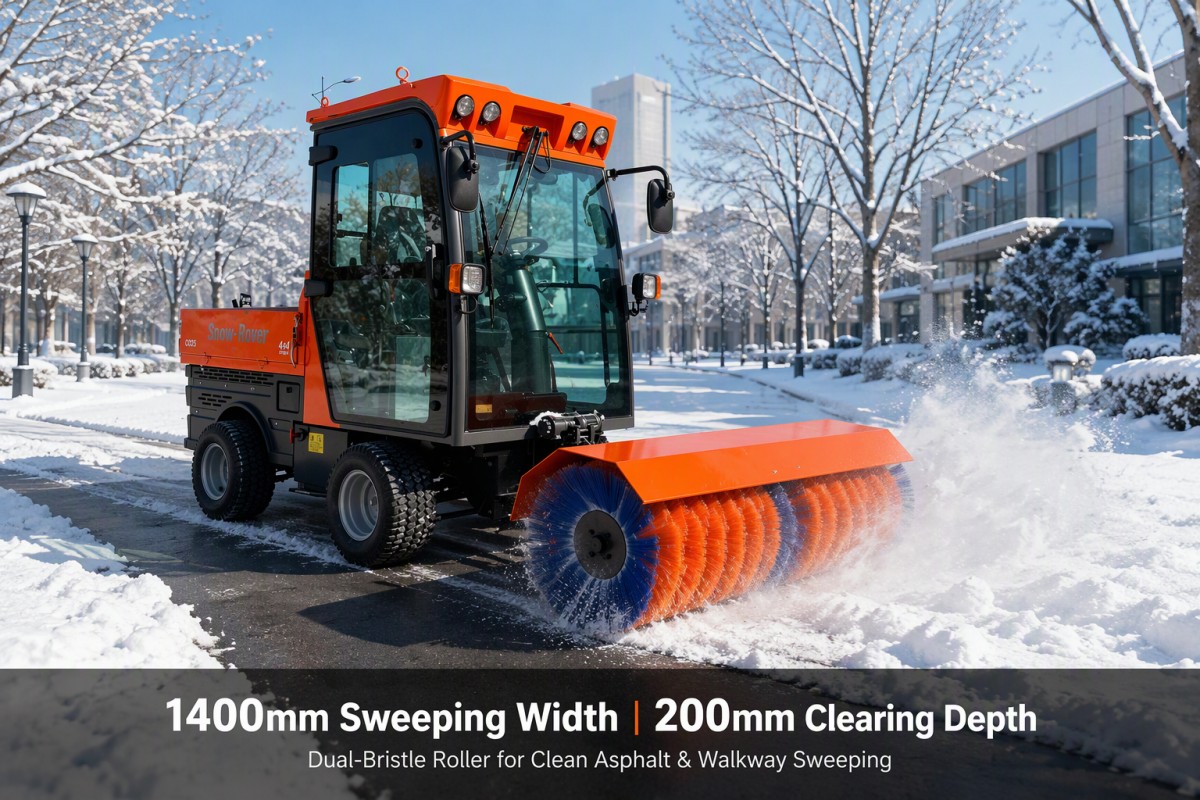
The roller brush is suited to light snow, surface residue, grit and seasonal debris on hard routes. It is most effective after bulk snow has been moved, when the goal is a cleaner and more even surface along driveways, kerb lines, paved yards and pedestrian approaches. The brush should not be treated as the first choice for deep snow or loose aggregate.
02 Snow thrower for depth and windrows
The snow thrower is the tool for deeper accumulation, packed banks and open areas where snow needs to be carried away from the route. The published thrower configuration is 1,200 x 600 mm, with snow depth up to 60 cm. Discharge direction must always be planned before work begins, keeping people, vehicles, glazing and entrances outside the discharge line.
03 Push blade for bulk movement
The 1,500 x 400 mm push blade is suited to long straight runs, windrows and the first movement of bulk snow. It can quickly open a lane or parking area, but the operator should slow down around fixed ironwork, uneven paving, drainage covers and edges that may catch the blade.
04 Spreader for the final treatment
The spreader belongs at the end of the clearing sequence. Once the snow is removed and the surface is visible, salt or sand can be applied where ice control is required. Spreading before clearing wastes material because the snow and treatment material leave the site together.
How to use the 4WD140 across a complete clearing route
A repeatable sequence helps the operator select the correct tool and avoid unnecessary passes. The exact order changes with site layout, but the operating logic remains straightforward.
Safety boundary: attachment selection does not replace a site risk assessment. Stop before people, vehicles or property enter the working zone, and follow the attachment supplier's operating instructions.
Where the 4WD140 fits
The machine is suited to sites where winter maintenance includes more than one surface or more than one type of snow condition. Its ride-on format is useful when routes are repeated and the operator needs a clear view of the working area.
The same chassis can also support shoulder-season cleaning work when the selected brush is appropriate for the surface. Sand, grit and light debris can be handled on suitable hard routes, helping the machine remain useful beyond a single snowfall event.
Changing attachments without making the machine complicated
The 4WD140 is designed around a front connection point that allows the working tool to be changed according to the job. The changeover concerns the front attachment, its drive or hydraulic connections and the mechanical locking points; the chassis, cab and main drive system stay in place. No specialist tool is required for the normal attachment change procedure described for this configuration.
A practical changeover routine is simple: park on level ground, lower the attachment, stop and isolate the machine, release the connection, disconnect the relevant lines, fit the next tool, secure the lock and inspect the full connection before restarting. The operator should then test the attachment at low speed in a clear area before returning to the main route.
Attachment connection detail shown in the 4WD140 product image set.
Published configuration
Safety and operating boundaries
● Keep people, vehicles and glazing outside the snow thrower's discharge line.
● Do not brush loose gravel or aggregate where bristles may project stones.
● Approach block paving, drains, kerbs and fixed ironwork at controlled speed.
● Stop the machine and isolate power before disconnecting an attachment or hydraulic line.
● Inspect the attachment lock, hoses, guards and working area before each shift.
● Use the enclosed cab as an operator-protection feature, not as a substitute for route control and visibility checks.
FAQ
How many attachments are included in the 4WD140 configuration?
The configuration is built around four functions: sweeping, throwing, pushing and spreading.
Which attachment should clear deep snow?
The snow thrower or push blade should handle bulk and depth. The roller brush is better suited to light snow and finishing work.
Can the brush be used on gravel?
It should not be used on loose gravel or aggregate where the bristles may throw stones.
When should the spreader be used?
After snow has been cleared and the exposed surface has been checked. Treatment applied before clearing is carried away with the snow.
Does changing tools require a different chassis?
No. The four-tool concept keeps the ride-on chassis in place while the front working attachment changes for the route.
What makes the machine suitable for repeated routes?
The ride-on platform combines 25 HP power, CVT control, multi-gear four-wheel drive, an enclosed heated cab and attachment selection for different conditions.
This stunning beach house property is a true oasis, nestled in a serene coastal community with direct access to the beach.
Contact
West Street, Melbourne Victoria 3000 Australia