


Navigation
Contact us
Phone
Message
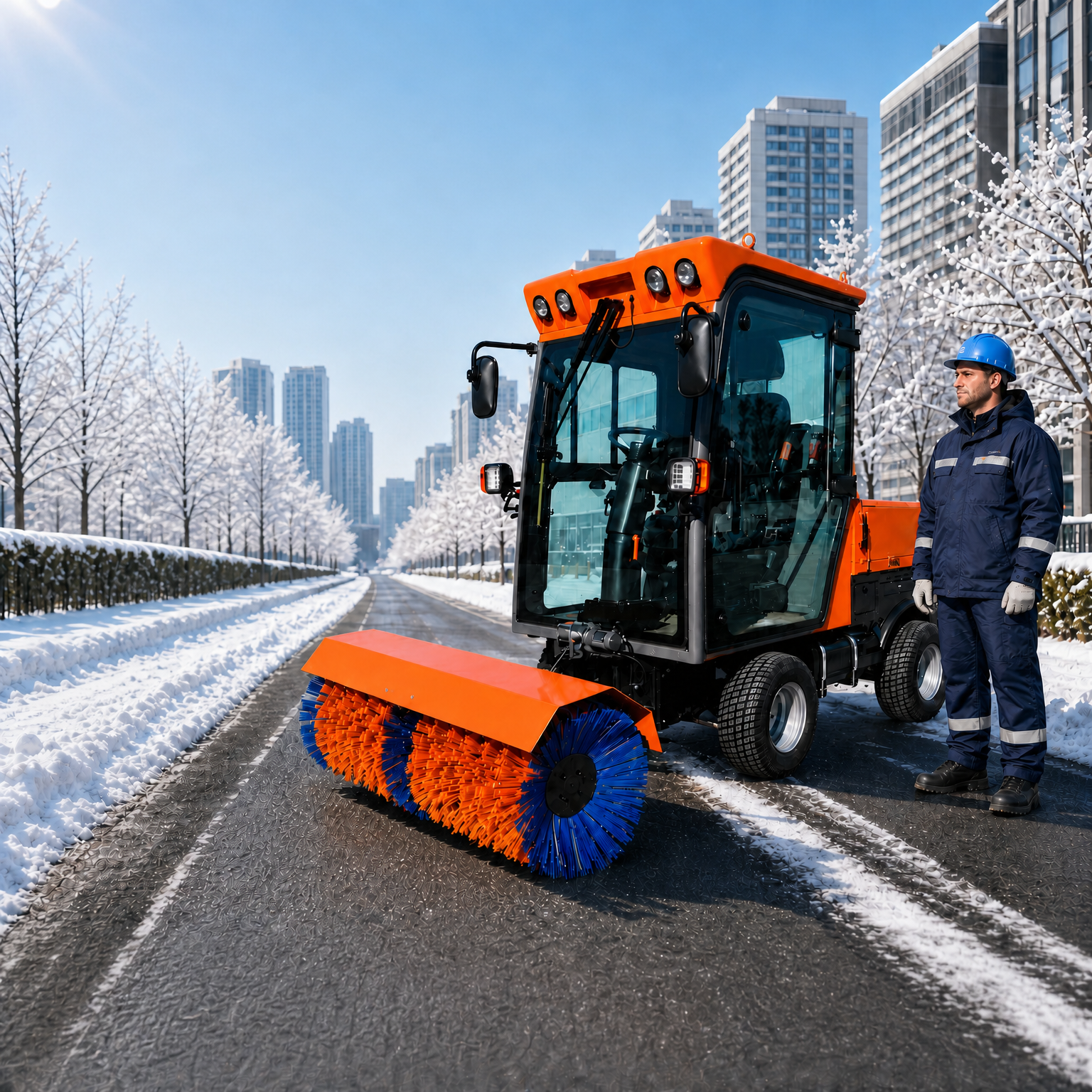
A pre-season selection and stocking guide for contractors, municipal crews, facility managers, estates and large-property owners, built around the VOER 1000T-Pro remote-control snow thrower and the VOER 4WD140 ride-on multi-functional snow sweeper.
Snow equipment is bought in the wrong month more often than it is bought wrong. An order placed after the first storm arrives after the third one, the parts that should be on the shelf are on a ship, and a machine chosen on price turns out to be the wrong class for the site it was bought for. None of those failures is fixed by a better specification sheet. They are fixed by deciding early, deciding by job, and stocking the parts that actually fail.
1. Start With the Snow and the Site, Not the Specification
Begin with the conditions the machine will work in. Record the snow depth you have to clear, whether it arrives evenly or drifts into place, whether it is light and dry or wet and heavy, the surface under the snow, the slopes on the route, the narrowest gap the machine has to pass, and how many hours it runs in a single storm. Those answers eliminate most of the range before you compare a single engine.
Two of them decide more than the rest. The first is depth. A machine sized for the depth you need in one pass is productive; a machine sized for half of it doubles the passes on the worst day of the year. The VOER 1000T-Pro is rated with a snow clearing depth of 600 mm (23.62 in.) and a snow throwing width of 1,000 mm (39.37 in.). The VOER 4WD140 clears 600 mm (23.62 in.) when throwing snow and 200 mm (7.87 in.) when sweeping with its roller brush.
The second is the surface. Paved, level ground and unsealed, sloped ground put the same machine under completely different loads, and they reward different drive systems. Get this one wrong and you buy a machine that is fully capable on paper and unproductive on your site.
There is a planning rule worth applying to the whole exercise: a machine specified for the worst week of the year will spend most of the season working well inside its limits, while a machine specified for an average week will reach its limits exactly when the schedule is least forgiving. Compare the duty cycle you actually run, not the one you hope for.
2. Match the Machine Class to the Work
Once the site is defined, the choice narrows to a class rather than a model. The three classes below are separated by where they are used and who is standing next to them, not by budget.
The dividing line between the second and third class is worth stating plainly. A remote-control tracked thrower exists for the ground an operator should not be standing on: slopes, ramps, ice, unsealed tracks, and shared surfaces where traffic, pedestrians or slope edges make walking beside the machine the real risk. A ride-on sweeper exists for the opposite problem: large paved areas that must be cleared repeatedly, where the constraint is how many hours an operator can keep working rather than where they can stand.
Where the site has both, the two classes are complementary rather than competing. A municipal depot may run a ride-on sweeper over roads, footpaths and aprons and keep a remote-control tracked thrower for the ramp, the yard edge and the access routes that the sweeper cannot reach or should not enter.
3. Read Width, Depth and Power as One Set
Clearing width is the number buyers notice first, and it is the worst number to shop on alone. On the VOER 4WD140 there are three working widths, because there are three front attachments: 1,200 mm (47.24 in.) for snow throwing, 1,400 mm (55.12 in.) for snow sweeping and 1,500 mm (59.06 in.) for snow plowing. The width you plan around is the width of the attachment in your order, and the figures are not interchangeable.
Read them together with the depth figures, because width and depth trade against each other. A 1,200 mm throwing attachment moves snow further and faster than a wider blade can, while a 1,500 mm plow clears a wider lane but relocates snow rather than removing it from the surface. On the same machine, 200 mm is the sweeping depth and 600 mm is the throwing depth - a difference that comes from the attachment and the brush, not from the engine.
Power belongs in the same reading. The 1000T-Pro runs a Loncin 420 cc petrol engine rated at 15 HP, and the 4WD140 a Zongshen 740 cc petrol engine rated at 25 HP; both carry EPA / Euro 5 certification. Power reserve matters most in wet, heavy snow and over long clearing sessions, and it is the reason two machines with similar working widths are not comparable on a horsepower figure alone.
4. Decide Who Operates It, and Where They Stand
How a machine is controlled is a working condition, not a convenience feature. On the VOER 1000T-Pro the operator works from a distance, with a control range of 500 m and a chute that rotates through 360 degrees, and the machine is quoted with a climbing angle of 45 degrees. That combination is what allows the same unit to clear a sloped driveway, a ramp or an unsealed yard without the operator standing on the slope to do it.
Two questions decide what happens on a bad day with any remotely controlled machine, and both should be answered in writing before you order. First, what does the machine do if the control signal is lost or interrupted - does it stop, hold position, or continue? Second, how much does the working range fall when buildings, vehicles or other machinery stand between the operator and the machine? A quoted range is a rated figure, not a guarantee in a built-up site.
The ride-on class answers a different question. The VOER 4WD140 is supplied with an enclosed cab with a glazed windscreen and side windows, roof-mounted work lights and mirrors, and it starts electrically. On a machine that may run eight or ten hours through a storm, that is not a comfort extra - it is what keeps the operator warm, dry and able to see, and visibility at the end of a long shift is where most small snow-clearing errors begin.
5. Compare the Two Machines Side by Side
The table below puts the two VOER snow machines on the same definitions and units, which is the only way width, depth and weight figures can be compared at all.
Read it as a system rather than a scoreboard. The 1000T-Pro clears a narrower path and is the machine for sloped, unsealed and shared ground, for narrow access, and for sites where the operator has to stay clear. The 4WD140 clears wider and carries an operator in a cab, and it is the machine for large paved areas that are cleared repeatedly through a long storm.
6. Stock the Consumables Before the Season Starts
Snow equipment is judged in the middle of a season, when one missing part stops the whole schedule. A machine that cannot be repaired promptly in February costs more than a machine with a higher purchase price and a stocked parts shelf. Build the list before you order, not after the first breakdown.
Then price them into the quotation rather than discovering them later. Wear items on both machines should be treated as a running cost per working hour, quoted alongside the machine, so the total cost of ownership is visible before the season begins rather than after it.
7. Place the Order on the Calendar, Not on the Weather
Production, ocean freight and customs clearance all sit between placing an order and putting a machine into service. Work backward from the date your first snow normally arrives, subtract the transport and clearance you should expect on your route, and treat the result as your order deadline rather than the first storm as your trigger.
Freight planning belongs in the same decision, because the two machines differ in shipping volume by nearly four times: about 2.04 m3 packed per 1000T-Pro against about 7.77 m3 packed per 4WD140, at gross weights of 340 kg (750 lb) and 747 kg (1,647 lb). On most routes a shipment of this size is rated on volume rather than weight, so have the packing data in hand before you book, and check both figures with your forwarder before comparing quotations from different suppliers.
Two ordering decisions are easy to get wrong and expensive to correct. Specify the optional front cutting attachment for the 1000T-Pro in the same order if you want year-round use, because ordering it later means a second shipment and a second freight charge for an 800 mm cutting attachment you could have shipped with the machine. And state your destination market when you request a quotation, because documentation requirements differ between markets even where the engine certification is the same.
Who Each Machine Suits
Safety note: Never clear a blocked auger, brush or discharge chute by hand or with your feet - shut the engine down, remove the key, wait until all movement has stopped, and use a clearing tool. Keep all guards, shields, covers and the chute in place while the machine is running, wear eye protection and slip-resistant footwear when working around it, and keep bystanders well clear of the discharge side. On slopes, operate the 1000T-Pro remotely from a safe position; on the 4WD140, keep the cab door closed and stay seated while the machine is working. Never leave a machine running unattended, and operate only according to the manual.
FAQ
When should snow removal equipment be ordered?
Before the first snow, with enough margin for production, ocean freight and customs clearance. Work backward from your historical first-snow date and treat the result as the order deadline rather than reacting to the first storm.
Which is better, a remote-control snow thrower or a ride-on snow sweeper?
Neither is better in general - they are built for different duty. The 1000T-Pro suits sloped, unsealed and shared ground, narrow access and sites where the operator must stay clear. The 4WD140 suits large paved areas cleared repeatedly, where wide working widths and an enclosed cab keep the work going through a long shift.
How much snow can each machine clear in one pass?
The 1000T-Pro is rated with a 1,000 mm (39.37 in.) snow throwing width and a 600 mm (23.62 in.) snow clearing depth. The 4WD140 clears 600 mm (23.62 in.) when throwing snow and 200 mm (7.87 in.) when sweeping with its roller brush. Real output depends on snow type, moisture, surface and travel distance.
How wide does each machine clear?
The 1000T-Pro clears a 1,000 mm (39.37 in.) path. The 4WD140 is quoted with three widths - 1,200 mm (47.24 in.) throwing, 1,400 mm (55.12 in.) sweeping and 1,500 mm (59.06 in.) plowing - each of which corresponds to a different front attachment, so the figure you plan around is the one in your order.
Is the VOER 1000T-Pro remote controlled?
Yes. It is remotely operated with a control range of 500 m, and the chute rotates through 360 degrees. In practice the working range is reduced when buildings, vehicles or machinery stand between the operator and the machine.
Can the 1000T-Pro do anything besides clearing snow?
Yes, as an option. A front cutting attachment can be specified with an 800 mm (31.5 in.) cutting width, a 20-120 mm (0.79-4.72 in.) cutting height and a straight blade. It is an option rather than part of the standard machine, so it has to be specified in the order.
What should be stocked before the season starts?
For the 1000T-Pro: skid shoes and auger protection parts, drive belts and track-system wear items, and a spare remote battery. For the 4WD140: the roller brush and plow edge, wiper blades and cab glass, and the fixtures used for attachment changeover. Both machines: belts, filters, lubricants and the documentation set.
What affects freight cost on these machines?
Packing volume more than weight on most routes. The 1000T-Pro packs to about 2.04 m3 per unit at a gross weight of 340 kg (750 lb); the 4WD140 packs to about 7.77 m3 at a gross weight of 747 kg (1,647 lb). Confirm both figures with your forwarder and check how many units fit the container you intend to book.
Summary
Choosing snow removal equipment before the season comes down to job fit rather than a single specification. Define the snow depth, the surface and the hours first. Then pick the class: a remote-control tracked thrower where the ground is sloped, unsealed or shared and the operator should stay clear, and a ride-on sweeper where large paved areas have to be cleared repeatedly through long shifts. Read width, depth and power as one set, and treat the control method - remote or cab - as a working condition rather than a luxury.
The VOER 1000T-Pro packages a 1,000 mm snow throwing width, a 600 mm clearing depth, a 360 degree rotating chute, a 45 degree climbing angle and 500 m remote control into a tracked machine, with an optional 800 mm front cutting attachment for year-round use. The VOER 4WD140 packages a 25 HP engine with electric start, full-time 4WD with hydraulic drive, three working widths of 1,400 mm sweeping, 1,200 mm throwing and 1,500 mm plowing, and an enclosed operator cab. Stock the consumables and place the order well before the first snow, and compare configurations against your actual working conditions rather than choosing on price alone.
This stunning beach house property is a true oasis, nestled in a serene coastal community with direct access to the beach.
Contact
West Street, Melbourne Victoria 3000 Australia